
Internship on Curaçao: a practical guide for international students
A few months on Curaçao as an intern is not the same as a two-week beach trip. Housing, transport, banking, connectivity and cultural fit all matter more when you are actually working on the island. This guide walks through what international students should arrange, in roughly the order it comes up.
The content below focuses on the practical side: what to do before you fly, what to expect in your first weeks, and the choices that genuinely affect how smooth the internship feels. Where a specific partner or service makes a concrete difference, we mention it with context so you can decide yourself.
Why Curaçao is a strong choice for your internship
Curaçao sits outside the typical European internship destinations, which is precisely why it stands out on a CV. Companies on the island deal with a mix of Dutch, English and Spanish-speaking clients, so you end up operating in an international context that is hard to replicate in a home-country placement. At the same time, the business culture is small enough that interns regularly sit in meetings they would never enter at a large European firm.
The daily environment is a factor too. Workdays end around 5pm, the weather is stable, and the ocean is ten minutes from almost any office. For four to six months that rhythm matters: it is easier to sustain focus at work when the rest of your life is simple. The downside is that everything familiar (your bank, your phone provider, your pharmacy) works differently, which is why preparation pays off more here than on a European placement.
Sectors with regular demand for interns include hospitality and tourism, marketing and communications, financial services, HR, healthcare, and commercial and logistics roles. Software development placements exist but are fewer in number. Your academic field will mostly determine where you end up, but the island is small enough that switching employers during a placement is unusual.
How early should you start planning
Three months before your intended start date is the realistic minimum. Two months is tight, and under six weeks is rarely workable once you account for placement search, housing, insurance and flights.
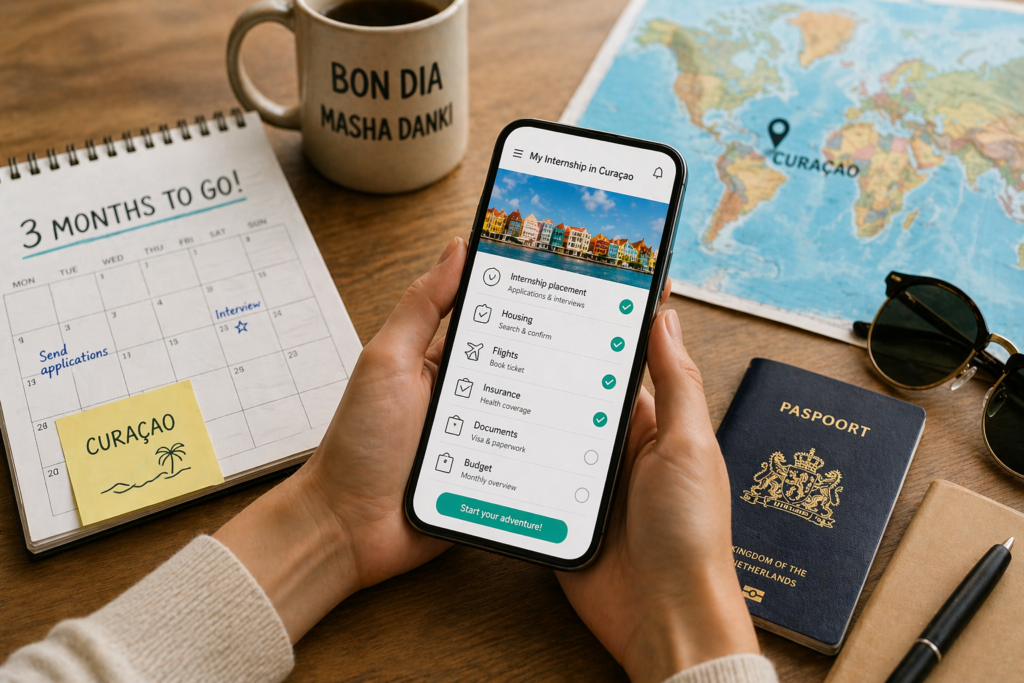
The chain of dependencies is what makes early planning important. You cannot confirm housing until you know which part of the island you work on. You cannot book flights until the start date is fixed. You cannot arrange insurance until you know your exact duration. One delay cascades into the next, and agencies and landlords book up fastest for the traditional February and September starts.
Finding your internship placement
There are two routes that work, and most students end up using a mix.
Through a placement agency
Placement agencies remove a lot of the logistical work: they have an existing network of companies, they know which firms actively accept interns, and they handle housing and airport transfer as part of their service. The trade-off is a fee.
For Dutch students, CuracaoStage.nl is one of the established options. They charge a one-time €549 under a no-cure-no-pay model (you only pay when you accept an offered placement), have around 50 recognised partner companies across sectors, and arrange housing and airport transfer as part of the package. Their Dutch-speaking point of contact on the island is useful for students who prefer to do paperwork and intake in Dutch. Lead time from registration to confirmed placement is typically four to six weeks.
For non-Dutch international students, placement agencies specific to Curaçao are thinner on the ground, and many interns arrange placements directly.
Direct outreach
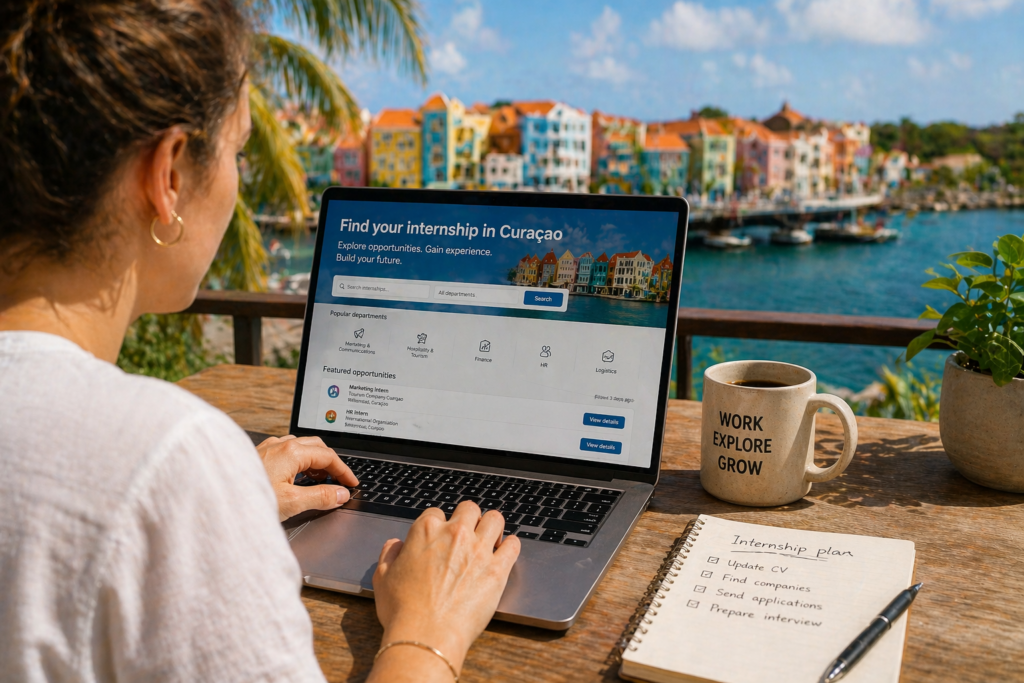
The direct route works well if you already have a sector in mind and are comfortable with LinkedIn outreach and cold email. Identify five to ten companies in your field, find the HR or management contact, and send a short professional email explaining your study programme, target dates, and why their work interests you. Response rates are higher than in Europe because the pool of applicants is smaller. Follow up once after a week if you have not heard back.
Whichever route you take, get the internship contract and company registration checked before booking anything non-refundable.
Visa and documentation
Curaçao is a constituent country of the Kingdom of the Netherlands, which matters for paperwork. Dutch citizens and most EU nationals can stay up to six months on arrival without a visa, using only a valid passport. Non-EU students need to check with the Dutch representative in their country of origin well before travel, as requirements vary by nationality.
Independent of visa status, bring or have digital copies of: a signed internship contract, proof of enrolment at your home institution, a return or onward flight, proof of sufficient funds for your stay, and valid health insurance that covers Curaçao (more on that below). Immigration at Hato Airport asks to see at least some of these at entry.
If your stay extends beyond six months, you will need a residence permit, which has to be arranged from Curaçao itself with the IND-CW office. Most interns plan around the six-month cap to avoid this.
Housing options and costs
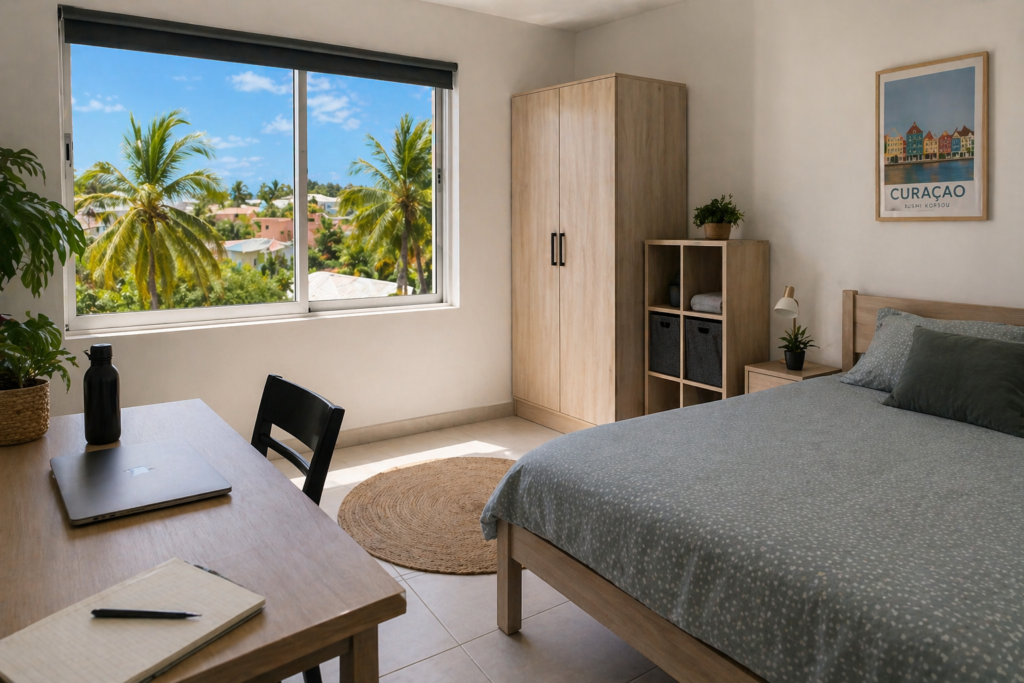
Shared student houses are the default and typically the most affordable option. Rooms in a shared house in neighbourhoods like Mahaai, Saliña or Punda run from €450 to €700 per month all-in, depending on location and how new the house is. Agencies and housing coordinators often have a short list of trusted landlords with recurring student rotations.
Private apartments or studios are possible but push monthly housing to €900 and up. Airbnb works for a month at most; after that the weekly rates become uneconomical compared to a local rental. If you arrange housing directly, ask for a video tour before paying any deposit and confirm that utilities are included (in Curaçao they are often billed separately and can add €50 to €100 per month in summer due to air conditioning).
Start looking at least six to eight weeks before arrival. The student housing market is small and highly seasonal.
Money and banking
The local currency is the Netherlands Antillean Guilder (ANG), pegged to the US Dollar at roughly 1.79 ANG per USD. Most shops and restaurants also accept USD, and card payments are widespread in tourist areas but less so in smaller neighbourhoods.
Bring at least two working payment cards, ideally from different banks. Cards from Dutch banks (ING, Rabobank, ABN AMRO) work at ATMs and most terminals without issues. Some smaller merchants are cash-only, and occasionally a terminal will refuse foreign cards, so keep enough ANG or USD in cash for a few days of expenses.
Opening a local bank account for a six-month stay is usually not worth the administrative overhead unless your internship specifically pays you in ANG. Most interns use their home bank cards plus occasional cash withdrawals.
Staying connected: phone, data and what interns actually need
This is where most travel checklists give generic advice that does not fit a longer internship. The typical recommendation (get a tourist eSIM before you fly) works for a two-week holiday but falls short for four to six months. Here is why and what to do instead.
Tourist-grade eSIMs (the Airalo, Holafly and Nomad-style products) give you mobile data and nothing else. No local phone number, no voice calls, no SMS. For a short holiday that is fine, because most holiday communication is by WhatsApp or iMessage. For a working internship it creates specific problems:
- Banking authentication. Both your home bank and any local services you sign up for (gym, healthcare, delivery apps) rely on SMS codes for verification. Without a local number, foreign-SMS delivery is often slow or unreliable, especially for time-sensitive verification codes.
- Employer and landlord contact. Your employer, HR, and landlord all expect a local number they can call or text. “WhatsApp me on my Dutch number” works once but gets tiring fast.
- Emergency services. 911 (the local emergency number) works best with a local network registration.
- Papiamento-only messages. Some school, bank or government services send authoritative messages by SMS, not app.
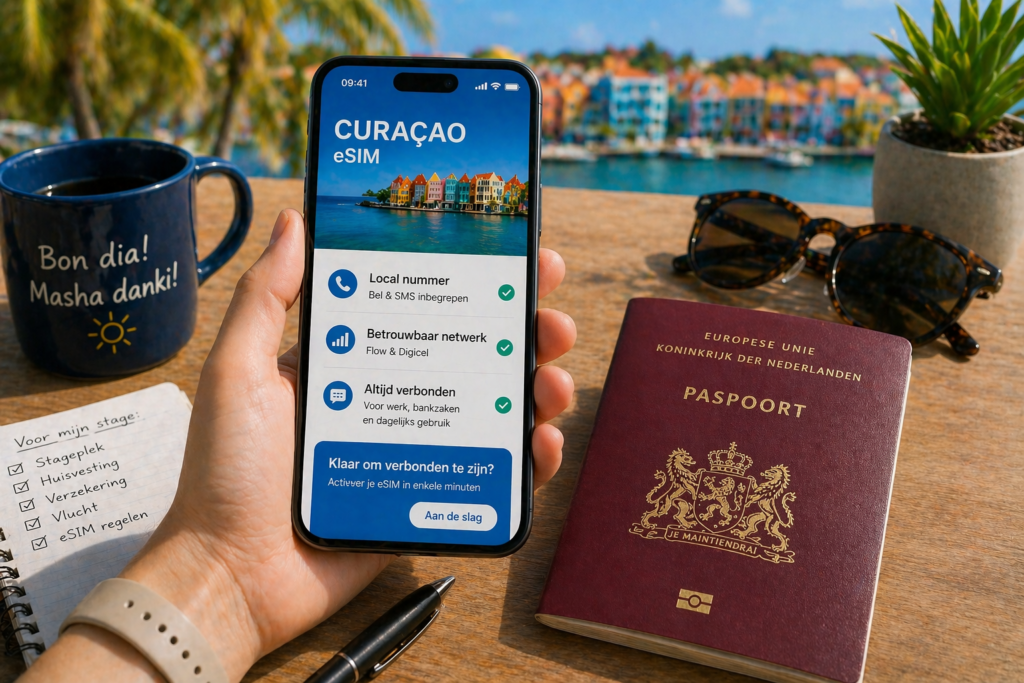
A local Curaçao eSIM with a real Curaçao phone number and voice and SMS included solves this. It runs on the local Flow or Digicel network, authenticates you instantly for local services, and reserves your existing home number for friends and family via a dual-SIM setup on your phone. Our Curaçao eSIM page lists the current packages aimed specifically at longer stays.
If you only remember one thing from this section: the cheap tourist-eSIM is a shortcut that costs you time and friction once you are actually on the island for months. The extra few euros a month for a real local number pay back immediately.
Transport
Curaçao has no train network and limited bus service outside central Willemstad. Most interns arrange transport in one of three ways: renting a car for the full placement (€300 to €500 per month), buying a used scooter or bike for onward resale, or sharing rides with housemates if you all work in the same area.
A car is the simplest option for flexibility but eats into the monthly budget. Bikes work in central Willemstad and Saliña but become impractical when the heat and distance add up. Bus transport is cheap but schedules are loose and evening service is thin.
A tip that travel blogs miss: car rental for stays over two months is significantly cheaper when arranged with local operators on-island rather than pre-booked through international sites. Arrive with a rental for the first week, then shop around locally.
Budget breakdown per month
Realistic monthly costs for an average intern in a shared house, excluding one-time expenses like flights and agency fees:
- Housing (shared room with utilities): €450 to €700
- Food (mix of cooking at home and eating out): €350 to €500
- Local transport (shared car or bus): €150 to €400
- Mobile connectivity (local eSIM with voice and SMS): €20 to €40
- Healthcare or insurance top-up: €30 to €70
- Leisure (bars, activities, occasional weekend trips): €200 to €400
The realistic spread is wider than placement-agency benchmarks suggest. Cooking at home, sharing a car with housemates and limiting weekend trips brings most interns to €1300 to €1500 per month. Renting a private room, eating out regularly and weekend trips to Bonaire or Aruba pushes the same setup to €1900 to €2100. The €1800 to €2000 figure agencies quote sits in a comfortable middle, not a lower bound.
For Dutch hbo and wo students: the gross figure overstates what you actually pay. Most students receive some combination of an internship stipend (around €200 per month is typical for hbo placements), DUO’s buitenland-OV reimbursement (€114.92 per month while abroad), and possibly an aanvullende beurs (€0 to €400 depending on parental income). Together these can offset €300 to €700 per month, bringing the net monthly cost closer to €1100 to €1500 for many students. Check duo.nl for current amounts and your specific situation.
Add one-time costs: flights of €500 to €1000 return, placement fee of €500 to €700 if you use an agency, insurance top-up if your base policy does not cover you, and a housing deposit of one month.
Daily life on the island
A few practical things that are easy to underestimate when you plan from Europe.
Language. Papiamento is the mother tongue, Dutch is the official language, and English is widely spoken in business and tourism. Most workplaces operate in Dutch or English. Learning the basic Papiamento greetings (bon dia for good morning, masha danki for thank you) is appreciated everywhere and opens doors in non-work settings.
Work culture. Hierarchy is lighter than in many European offices. Meetings start a few minutes late, dress codes are more relaxed (many offices are business-casual at most), and the pace of decision-making is slower. This is not a problem once you adjust; it is a problem if you arrive expecting a corporate European rhythm.
Weekends. Beaches, snorkel spots and weekend trips to neighbouring Bonaire or Aruba are genuinely part of the appeal and worth budgeting for. Interns who keep their heads down for six months rarely report back that they wish they had worked more.
Healthcare. Basic primary care is solid, but specialist care and dental can involve out-of-pocket costs. This is why the insurance point above matters more than it might seem.
Time zones. Curaçao is five hours behind Central European Time in winter and six in summer. Video calls with a Dutch or European employer or university work best before noon local time.
None of this is hard once you know it, which is mostly the point of a guide like this. The harder part is remembering to arrange the practical side three months before you fly, rather than two weeks before. If you do that, an internship on Curaçao is one of the more enjoyable ways to build professional experience.
Quick reference
- Start arranging your internship 3 or more months before your intended start date
- Verify the placement company is legitimate (Chamber of Commerce, recent reviews, actual address)
- Budget €1800 to €2000 per month all-in for housing, food, transport and modest leisure
- Get a local Curaçao phone number before arrival, not just a data-only travel eSIM
- Bring at least two working payment cards; some local merchants are cash-only
- Check whether your EU health insurance covers Curaçao; arrange a top-up if not
- Learn basic Papiamento greetings, which open doors on the island
Frequently asked questions
Do I need a visa to do an internship on Curaçao?
Dutch citizens and most EU nationals do not need a visa for stays under 6 months. Non-EU students should check requirements with the local Dutch representative for their country well in advance; agencies like CuracaoStage.nl can advise on documentation for Dutch students.
How much does an internship on Curaçao cost in total?
Realistic budget is €1800 to €2000 per month all-in, covering shared housing, food, local transport and modest leisure. Flights from Europe are €500 to €1000 return. Agency fees (if used) are a one-time €500 to €700.
Do I need to speak Papiamento or Dutch?
Papiamento is the mother tongue and opens doors socially, but most workplaces operate in Dutch or English. International students get by with English in most sectors. Learning basic Papiamento greetings is appreciated everywhere.
Which sectors have the most internship opportunities?
Hospitality and tourism, marketing and communications, financial services, HR, healthcare and commercial roles. Software development and engineering opportunities exist but are smaller in volume.
How do I arrange housing as an intern?
Most interns use shared student houses arranged through a placement agency or landlord referral. Independent Airbnb rentals work but are significantly more expensive for stays over a month. Start looking at least 6 to 8 weeks before arrival.
Will my European phone work during my stay?
It works technically, but Curaçao is outside EU roaming, so your home provider charges international rates that add up quickly. For a stay of several months, a local eSIM with a Curaçao phone number is more practical and far cheaper, especially since banking authentication and employer contact typically require a local number.
Do I need special travel or health insurance?
Yes. Standard EU health insurance often does not cover Curaçao, and regular travel insurance rarely covers multi-month stays. Check with your insurer about a specific internship abroad policy or a top-up for the duration of your placement.
How long should my internship be to make it worth it?
Most international students stay 4 to 6 months. Shorter than 3 months and the setup costs (housing deposit, flight, agency fee) dominate. Longer than 6 months often requires additional permits.
Last reviewed: 2026-04-22